Animal euthanasia to relieve suffering
All Creatures Great and SmallAnimal euthanasia to relieve suffering appears as a decision made under pressure, not as a routine end to treatment. In James Herriot’s cases, the veterinarian must judge what an animal’s condition means, explain the limits of care, and reckon with the attachment between animal and owner. The horse with suspected intestinal torsion makes the conflict especially stark: his suffering is severe and the prognosis hopeless, but his keeper resists euthanasia because the horse is valuable. Bob’s case reaches a different, completed outcome. There, a terminal internal growth and the dog’s distress lead Dean to agree to an anaesthetic overdose, after which Herriot confirms that Bob is no longer in pain.
Clinical Judgment and Its Limits
The decision concerning the horse begins with a history of colic that has worsened over the course of the day despite repeated doses of a black draught. In the stable, Herriot finds a bay hunter in severe distress. His examination reveals abnormalities consistent with a twisted bowel, and the intensity and persistence of the pain support the suspicion. The diagnosis is not presented as a certainty detached from examination: Herriot first says that he cannot identify the cause without assessing the horse, then interprets what he finds and concludes that the evidence points to torsion.
That distinction matters because the proposed action follows from both diagnosis and prognosis. Herriot explains that the condition has no cure and that the horse is dying; continuing to wait would prolong pain without changing the likely end. He recommends putting the animal down immediately and says that its market value cannot alter the medical facts. The horse’s worth to its owner and the animal’s present suffering are competing considerations, but Herriot treats relief of suffering as the decisive responsibility.
The evidence also shows that diagnosis alone does not automatically settle the question of euthanasia. When Strawberry develops a faint swallowing difficulty and a slight snoring sound, Herriot considers a post-pharyngeal abscess. He explains the danger it could pose if it enlarged, prescribes treatment and hot-water fomentation, and checks on the cow over the following ten days as the abscess develops. The account emphasizes uncertainty, monitoring, and the possibility of relief through rupture; it does not record a decision to euthanize her. Similarly, when Herriot examines a cow with a uterine torsion, he can identify a live calf but also recognizes that delivery will not be easy. The supplied scene establishes a serious clinical problem, not an euthanasia outcome. Together, these cases distinguish a grave diagnosis from the separate judgment that an animal’s suffering cannot be relieved by treatment.
Bob: Prognosis, Consent, and Relief
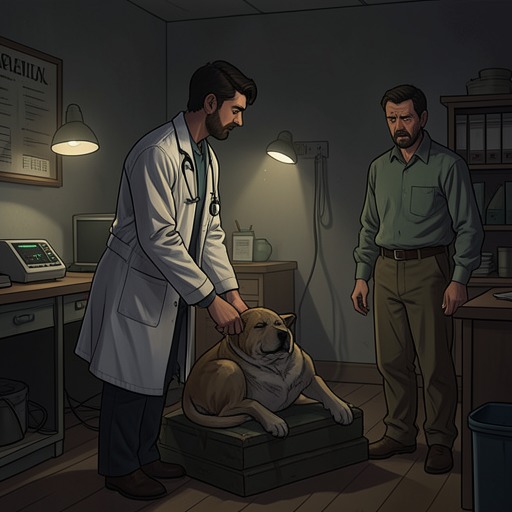
Bob’s case makes the reasoning for euthanasia explicit. The elderly dog has stopped eating and no longer follows his owner’s familiar routine of sitting beside him at mealtimes. Herriot observes signs of pain and a greatly enlarged abdomen, then feels a hard mass and diagnoses an enormous cancerous growth that cannot be operated on. He tells Dean that the disease has progressed too far for anything to be done. The choice is therefore not framed as treatment versus convenience, but as whether to spare Bob the worsening distress Herriot expects if he is left to die without intervention.
Dean must absorb that prognosis before he can decide. At the news that the growth is cancer, he asks whether Bob is going to die; Herriot answers by explaining why he believes it would be kinder to put the dog to sleep. Dean does not respond immediately. He kneels beside Bob, strokes the dog’s muzzle and ears, and takes time with him before asking Herriot to proceed. The scene gives the owner’s consent its own emotional and practical weight: the decision follows an explanation of the condition and a private moment of farewell, rather than being treated as a purely technical act.
Herriot describes the injection as an overdose of an anaesthetic and reassures Dean that it will be painless. As it takes effect, Bob relaxes and dies. Dean asks whether it is over; Herriot confirms that the dog is out of pain. The outcome is measured in the language of relief, while the owner’s restrained gratitude acknowledges what the procedure has cost him as well as what it has spared Bob. Herriot declines payment, saying that he was passing nearby and that the visit was no trouble. In a case shaped by care and loss, the waived fee further separates the act from a commercial transaction.
Resistance and Responsibility
The horse’s case differs from Bob’s not in the principle at stake but in the owner’s response and the stage at which the decision is shown. Soames objects that the horse is valuable and insists that Herriot’s senior colleague, Siegfried Farnon, might be able to cure him. He asks whether they can wait until Farnon returns. Herriot recognizes his own temptation to defer the decision and leave its burden to someone else. That hesitation is important: the narrative presents euthanasia not as an effortless exercise of professional authority, but as a choice Herriot would rather avoid making alone.
His attention returns to the horse’s continuing pain, and the animal’s distressed whinny resolves his hesitation. The episode thus sets the keeper’s hope of rescue and concern for the horse’s value against the immediate evidence of suffering and the absence of a cure. In the evidence presented here, Herriot recommends euthanasia, but the final act is not shown. That limit keeps the distinction between a veterinary judgment and its completion clear. Bob’s case, by contrast, records the owner’s agreement, the injection, and the resulting relief.
Attachment, Death, and the Animals Left Behind
The account of Miss Stubbs offers a related perspective on animal loss, though it is not a euthanasia scene. Bedbound for a long time, she remains chiefly concerned with her three dogs and two cats. When Ben dies, she touches his head before Herriot carries him away, then tells Herriot that she believes her own death will follow. Her anxiety is focused on whether she will be reunited with the animals she loves. She has read that animals have no souls, and asks Herriot for his honest belief rather than easy reassurance. He tells her that he believes her animals will go with her.
This exchange does not establish a general doctrine about animal souls, nor does it describe euthanasia. Its relevance lies in showing what the human-animal bond can make death mean to an owner: the fear is not only of losing a companion, but of permanent separation. Read alongside Bob’s farewell, the episode broadens the ethical context of end-of-life care. Veterinary decisions concern an animal’s pain and prognosis, but they also take place within relationships whose grief, loyalty, and hopes deserve serious attention.
Narrative Significance
Across these cases, euthanasia is tied to clinical observation and responsibility rather than to a single formula. Herriot weighs symptoms, examination findings, prognosis, and the prospects for relief; he also has to make his reasoning intelligible to owners who may be frightened or unwilling to accept what the evidence implies. The contrast between the inconclusive, monitored abscess in Strawberry and the incurable conditions in the horse and Bob’s case shows why judgment depends on circumstances, not merely on the presence of serious illness.
The decisive standard in the recorded choices is the animal’s suffering when recovery is no longer a realistic prospect. Yet the narrative does not erase the cost of acting on that standard. Soames resists, Dean grieves, and Herriot himself feels the pull of postponing responsibility. Bob’s quiet release supplies the clearest outcome: euthanasia ends distress that treatment cannot remedy, while the surrounding farewell makes clear that relief for the animal and sorrow for the human companion can coexist.